



(By Qurat ul Ain Ali Khawaja)
“From global investment outreach to domestic value addition, PMIF 2026 signals a strategic shift in Pakistan’s resource development agenda”
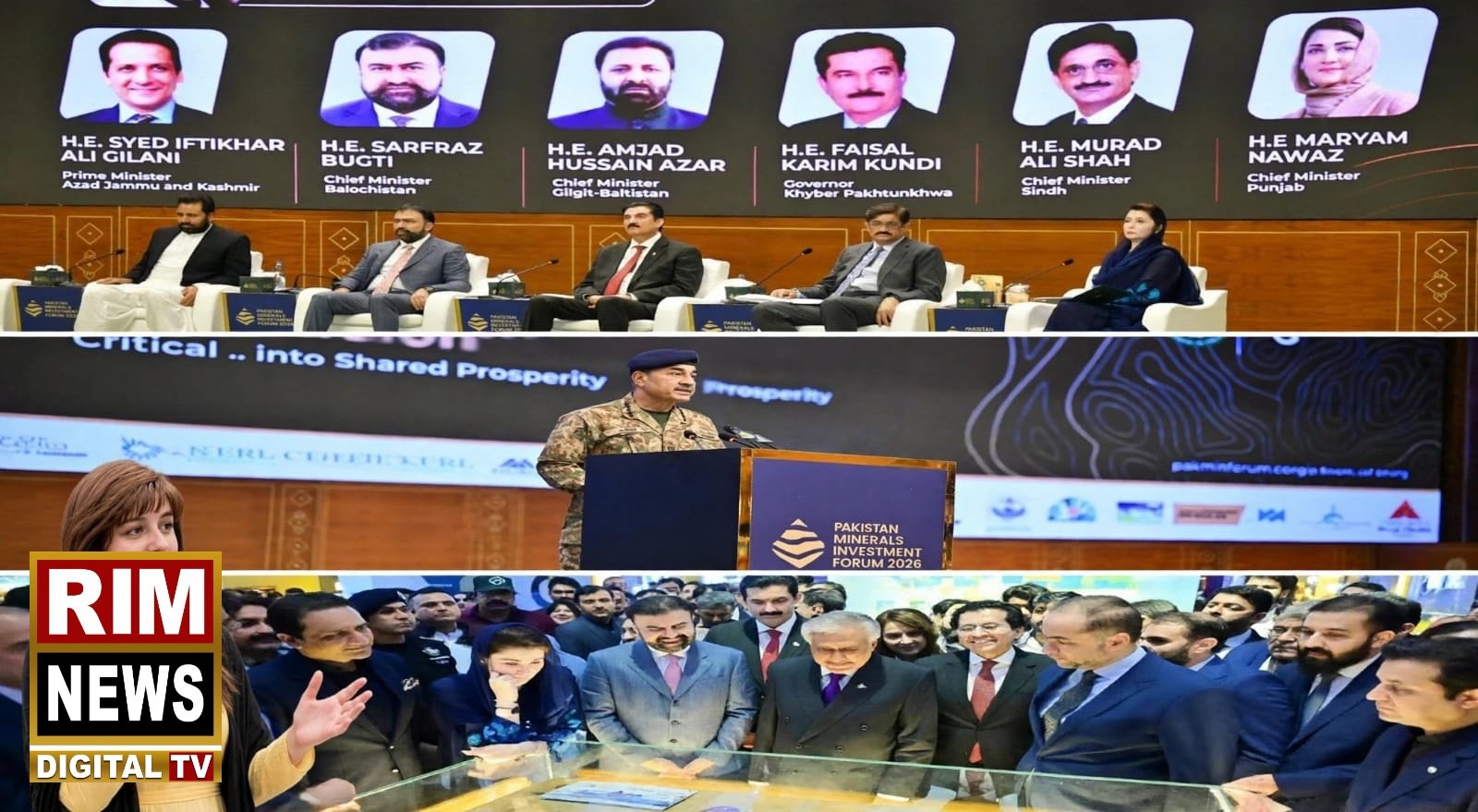
Pakistan’s mineral sector has emerged as a strategic frontier in the country’s economic transformation, with the Pakistan Minerals Investment Forum (PMIF) 2026 bringing national leadership, international mining executives, diplomatic representatives and provincial governments together to explore the potential of the country’s vast geological resources. Held on November 12 and 13 at the Jinnah Convention Centre, Islamabad, the two-day forum reflected a growing institutional focus on converting mineral wealth into sustainable industrial development, foreign investment and long-term economic stability.
Supported by the Special Investment Facilitation Council (SIFC) and the Oil and Gas Development Company Limited (OGDCL), the forum attracted participants from more than 60 countries. With Pakistan’s estimated mineral potential approaching $8 trillion, the gathering represented a significant opportunity to reposition the country within global critical-minerals and clean-energy supply chains. Its central message was that resource extraction alone would not be sufficient; domestic processing, technological advancement, transparent governance and investor confidence would be essential to achieving lasting economic gains.
The forum demonstrated a coordinated national approach to mineral development, with civil and military institutions highlighting the importance of security, policy continuity and investment facilitation. On the second day, Prime Minister Shehbaz Sharif outlined a roadmap aimed at shifting Pakistan away from the export of raw minerals towards domestic refining, processing and manufacturing. The inauguration of the National Minerals Database and the Geological Survey of Pakistan GeoPortal was particularly significant. These initiatives are intended to improve geological data accessibility, support evidence-based exploration and enhance transparency for prospective investors. Chief of Army Staff and Chief of Defence Forces Field Marshal Syed Asim Munir also underscored the importance of comprehensive security for mining operations, engineers and foreign investors. The emphasis on security reflects the strategic importance of protecting the mining ecosystem, particularly in resource-rich regions where infrastructure, operational stability and investor confidence remain critical. The forum’s institutional coordination projected a message of continuity and collective commitment. However, translating this confidence into sustained investment will depend on predictable regulatory frameworks, effective implementation, environmental responsibility and the equitable distribution of economic benefits.
The participation of provincial leadership was among the defining features of PMIF 2026. A major session, titled “Provincial Prospectivity to Prosperity: Insights from Chief Ministers,” brought together Punjab Chief Minister Maryam Nawaz Sharif, Sindh Chief Minister Syed Murad Ali Shah, Balochistan Chief Minister Sarfaraz Bugti, Gilgit-Baltistan Chief Minister Amjad Hussain Azar, Khyber Pakhtunkhwa Governor Faisal Karim Kundi and Azad Jammu and Kashmir Prime Minister Barrister Syed Iftikhar Ali Gilani. The participation of leaders from across Pakistan’s federating units highlighted the significance of regional coordination in mineral development. It also demonstrated that the future of the country’s resource economy will depend on provincial preparedness, institutional capacity and the ability to establish investor-friendly mechanisms. Punjab Chief Minister Maryam Nawaz Sharif presented a notable example of administrative reform, stating that Punjab’s mining revenue had increased fourfold, from Rs10 billion to Rs40 billion, within two and a half years. She attributed the improvement to digitised licensing and drone-based monitoring.Her investment proposals included subsidised financing of up to Rs5 billion, customs duty waivers, nominal land leases in a proposed mineral-processing zone in Khushab and one-window facilitation. She also highlighted placer gold deposits across Punjab’s five rivers and 261.5 million tonnes of iron ore in Chiniot.
The forum further featured the signing of 13 major agreements, including exploration-related partnerships in Balochistan’s Chagai district involving Ivanhoe Mines, Mari Minerals and Turkish partners. The reported discovery of 350 million tonnes of copper ore by the Frontier Works Organisation also underscored the scale of exploration activity and the growing importance of geological assessment.
For Azad Jammu and Kashmir, PMIF 2026 carried particular significance. AJK Prime Minister Barrister Syed Iftikhar Ali Gilani’s participation in the main leadership panel provided the region with a prominent platform to present its mineral potential alongside the country’s provinces.Addressing the forum, the AJK premier highlighted the region’s deposits and occurrences of precious and semi-precious stones, including ruby, tourmaline and topaz, as well as granite and industrial raw materials relevant to the cement sector. He invited international exploration, mining and infrastructure partners to consider investment opportunities across AJK’s mineral value chain. His emphasis on facilitation and transparent regulatory frameworks for responsible high-altitude mining reflected the need to balance economic development with the region’s geographical and environmental sensitivities. The visible interaction between AJK and Punjab’s leadership also carried broader implications for inter-regional cooperation. The engagement between Barrister Syed Iftikhar Ali Gilani and Maryam Nawaz Sharif reflected the potential for collaborative approaches to resource development, investment facilitation and regional economic integration.
AJK’s participation should therefore be viewed not merely as symbolic representation but as an opportunity to strengthen its institutional and economic preparedness. The region will require updated geological surveys, transparent royalty mechanisms, technical expertise, infrastructure development and meaningful consultation with local communities to translate international exposure into tangible benefits.
PMIF 2026 brought together prominent international mining and investment figures, including Barrick Mining Corporation Chairman John L. Thornton, Ivanhoe Mines Founder and Executive Co-Chairman Robert Friedland, International Resources Holding Head of Discovery Colin J. Davies and Wood Mackenzie’s Patrick Barnes.The participation of international executives and diplomatic representatives from North America, Europe, the Gulf and other regions reflected the increasing international attention directed towards Pakistan’s mineral resources.
Projects such as Reko Diq, which is targeting production by the end of 2028, remain central to the country’s longer-term mineral development outlook. Their potential economic contribution extends beyond exports to employment generation, infrastructure investment, technical training and the development of supporting industries. Nevertheless, the conversion of geological potential into economic prosperity will require more than investment announcements. Environmental safeguards, local value addition, technology transfer, workforce development and accountable resource management must remain integral to the national strategy.
The conclusion of PMIF 2026 presents Pakistan with an opportunity to move towards a more diversified and export-oriented economy. The forum’s significance will ultimately be measured by the implementation of its agreements, the establishment of operational projects and the extent to which mineral development contributes to public welfare. For AJK, the next phase should involve institutional preparation, geological documentation, skilled workforce development and transparent engagement with investors and communities. A responsible mineral economy could create specialised employment opportunities for young people, particularly in gemstone processing, engineering, geological sciences and sustainable extraction. Pakistan possesses considerable mineral potential, but resource wealth alone cannot guarantee economic sovereignty. The decisive factors will be governance, policy consistency, transparency and the capacity to ensure that the benefits of extraction are shared equitably.
PMIF 2026 has placed mineral development firmly within Pakistan’s broader economic conversation. The challenge ahead is to transform this national ambition into measurable progress one that strengthens the economy, empowers the regions and establishes a sustainable foundation for future generations.