






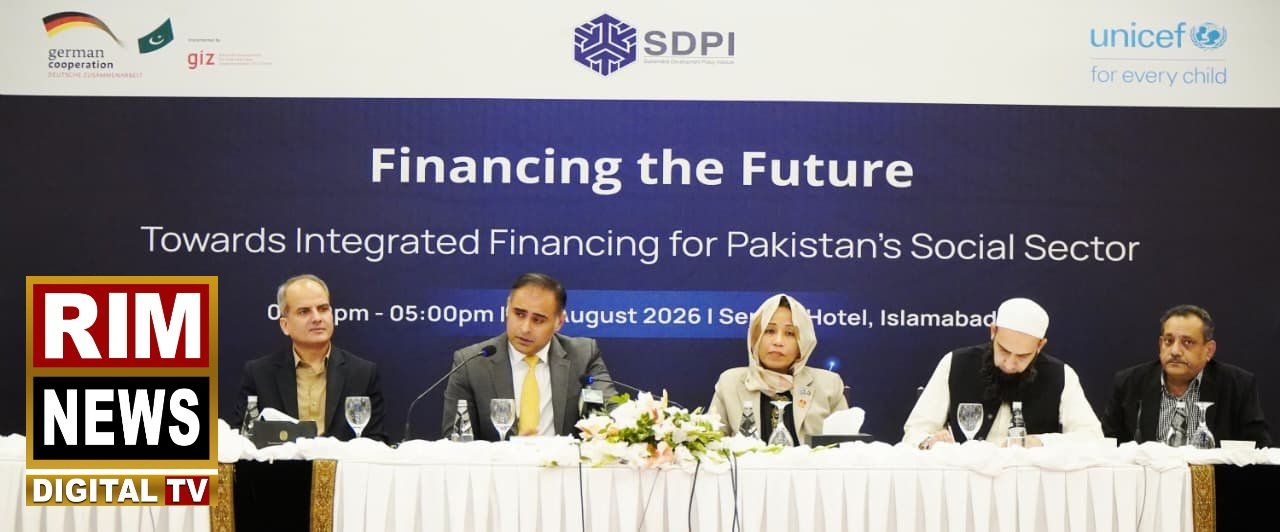
In light of the increasing financial pressure in Pakistan and the growing needs of the social sector, the government, the United Nations, and policy experts have emphasized the need to utilize alternative and collaborative financial resources for health, education, nutrition, and social protection. Experts clarified that Zakat, charity, corporate social responsibility, public-private partnerships, climate finance, and social bonds should not be alternatives to government funding but rather complementary to it. This was expressed at a high-level policy roundtable organized by the Sustainable Development Policy Institute (SDPI) and UNICEF Pakistan, in collaboration with GIZ, on the topic of “Financing the Future: Integrated Financial Strategy for Pakistan’s Social Sector.” The event also marked the launch of the “Financing the Future” initiative and its website.
Minister of State for Finance and Revenue Bilal Azhar Kiani stated that alternative financial sources should be tested on a limited scale first, followed by transparent operations and rigorous evaluation of results. He mentioned that there is encouragement for increased spending on corporate social responsibility and its transparent reporting. He also stressed the need for better coordination in the federal development program and provincial annual development programs, to prevent duplication of projects and to transfer resources to the grassroots level.
UNICEF Pakistan’s Deputy Representative Sharmila Rasool said that the focus of seeking additional financial resources should be on making a real difference in children’s lives. She noted that the measure of success for financial resources should not only be the amount raised but also transparency, equity, sustainability, and outcomes. Finance Advisor Adnan Pasha stated that human development in Pakistan needs to be understood as essential infrastructure rather than just social spending. He proposed a robust accountability and results-based system for private and philanthropic investment, emphasizing that private investment should not be seen as “free lunch” but should yield measurable social and financial outcomes.
Dr. Sajid Amin Javed, Deputy Executive Director for Research at SDPI, remarked that spending on health, children, and social protection is essentially an investment in Pakistan’s future. He mentioned that provincial resources are limited compared to the growing population and social needs, thus necessitating an increase in revenues, prioritization of expenditures, improved performance, and integration of alternative financial resources. UNICEF Pakistan’s Chief of Social Policy Sadaf Zulfiqar noted that according to a 2023 study, annual corporate philanthropic support in Pakistan is approximately $300 million; however, weak trust, limited transparency, and lack of institutional connectivity hinder fully leveraging this potential.
Dr. Shafqat Munir, Deputy Executive Director for Policy at SDPI, thanked the representatives of UNICEF, GIZ, and federal and provincial governments for their cooperation. Shah Muhammad Azhar, a representative from the United Nations Resident Coordinator’s Office, welcomed the initiative and assured support from his office for sustainable financing of the social sector. Participants agreed that the solution to the financial issues of the social sector lies not in a single source but in integrating government resources, private investment, Zakat, donations, and innovative financial sources into a transparent and results-based system.