


By Muhammad Awais Hamza.
Date: 14 August 2026
Master’s Programme, School of Economics and Management,
Yanshan University, Qinhuangdao City, Hebei Province, China.
Education has always been an important part of my life. Like many students in Pakistan, I grew up believing that hard work, good grades, and strong degrees were the main keys to success. But my understanding of education changed when I moved to China for my MBA at Yanshan University.
Studying in two different education systems—Pakistan and China—has been one of the most eye-opening experiences of my life. It is not just about classrooms or books. It is about teaching styles, student behavior, learning culture, and how education shapes thinking.
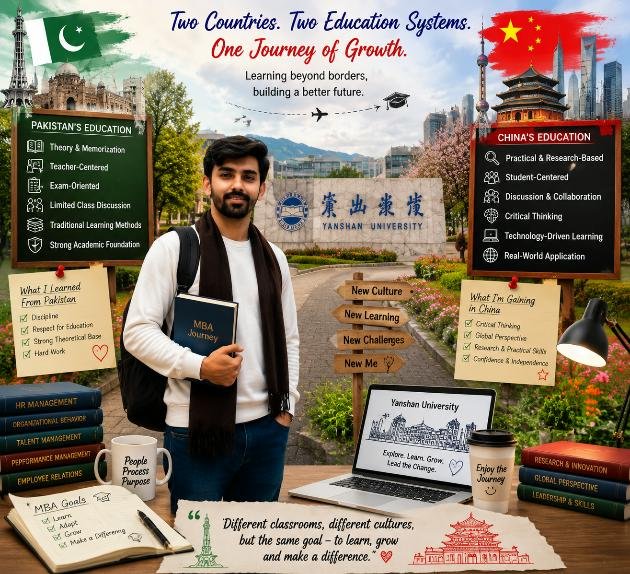
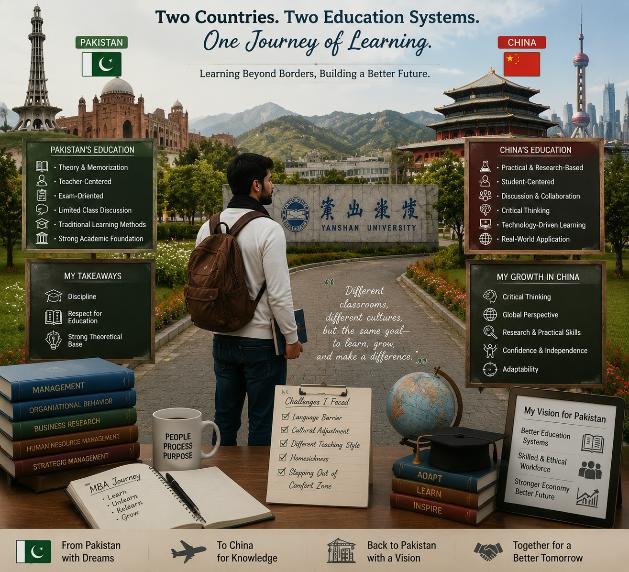
When I studied in Pakistan, the education system felt more focused on theory and memorization. Students often worked hard to prepare for exams, and success was usually measured by marks. Teachers played an important role in guiding us, and most learning came from textbooks and lectures. This system helped build a strong academic base, but it sometimes limited open discussion and independent thinking.
In contrast, when I came to China, I immediately noticed a different learning environment. At Yanshan University, education felt more interactive and research-based. Students are encouraged to ask questions, share ideas, and explore topics beyond the classroom. Instead of only memorizing information, we are expected to analyze and apply it in real-life situations.
At first, this change was not easy for me.
I remember sitting in my first few classes feeling confused and silent. In Pakistan, I was used to listening carefully and writing notes. But here, students were speaking, discussing, and challenging ideas openly. I felt like I needed time to adjust to this new way of learning.
Slowly, I started adapting.
One of the biggest differences I noticed was the focus on research and practical learning in China. In my MBA program, we are encouraged to connect theory with real-world business problems. Assignments are not just about writing answers—they are about thinking critically, analyzing data, and presenting solutions.
Another major difference is the use of technology in education. In China, digital tools, online platforms, and smart learning systems are widely used in classrooms. Even simple things like submitting assignments, accessing research papers, and communicating with teachers are more organized and technology-driven. This made learning more efficient and structured for me.
However, this journey was not without challenges.
Language was one of the biggest barriers in daily life, even though my program is in English. Outside the classroom, I had to learn basic Mandarin to manage everyday situations. This experience taught me patience and adaptability. It also helped me understand how international students struggle and grow in new environments.
Despite the differences, I also found similarities between the two education systems. In both Pakistan and China, teachers are dedicated and students are hardworking. Both systems value discipline and respect for education. The main difference lies in teaching style and learning approach rather than the importance given to education itself.
Another important learning for me has been cultural diversity in education. In China, I study alongside students from different countries. This exposure has helped me understand global perspectives and improved my communication skills. Group discussions with international classmates often lead to interesting debates, where everyone brings a different viewpoint based on their background.
Living and studying in China has also changed my confidence level. I have learned to speak up more, express my opinions, and think independently. In the beginning, I was afraid of making mistakes. But now I understand that mistakes are part of learning.
Looking back, I realize that both education systems have their strengths. Pakistan gave me a strong academic foundation and discipline in studies. China taught me how to think critically, research deeply, and apply knowledge in practical ways.
As a student, I believe the real value comes from combining both approaches. A strong theoretical base, like in Pakistan, and a research-driven, practical mindset, like in China, can create more complete and capable graduates.
My journey has shown me that education is not just about where you study—it is about how you learn, how you adapt, and how you grow as a person.
Today, I feel grateful for both experiences. One gave me roots, and the other gave me wings.
And as my MBA journey continues, I carry both with me.