






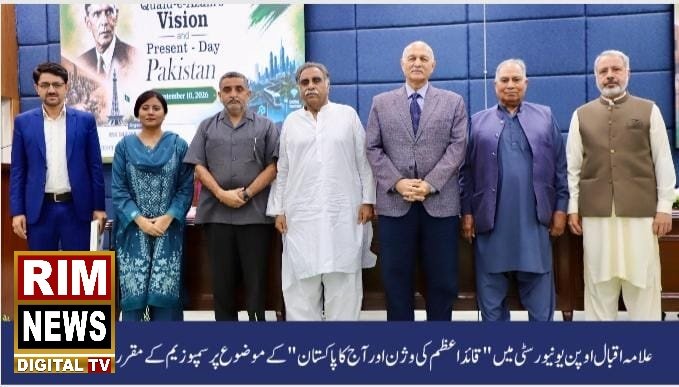
A symposium on “Quaid-e-Azam’s Vision and Present Pakistan” was held at the Open University.
Pakistan can be strengthened by adhering to the principles of Quaid-e-Azam: Makhdoom Hussain Syed
Islamabad (Staff Reporter) – Renowned Pakistani politician Makhdoom Hussain Syed stated that Quaid-e-Azam Muhammad Ali Jinnah’s vision was to establish a sovereign, strong, democratic, and prosperous Pakistan where the supremacy of the constitution and law, equality, social justice, human rights, religious freedom, and education are of fundamental importance. Speaking at the symposium on “Quaid-e-Azam’s Vision and Present Pakistan” held at Allama Iqbal Open University, he emphasized that to implement Quaid-e-Azam’s vision, education, human rights, women’s empowered participation, and the eradication of corruption must be national priorities. Professor Dr. Riaz Ahmed, while addressing the symposium, said that Quaid-e-Azam united the Muslims of the subcontinent and paved the way for the attainment of a free homeland, and his vision remains a guiding light for Pakistan’s development, stability, and prosperity today. He stated that through the supremacy of the constitution, rule of law, strengthening of institutions, and national unity, Pakistan can be made a strong and dignified country. Professor Dr. Abdul Aziz Sahir remarked that the true guardians of the thoughts and ideologies of Quaid-e-Azam and Allama Iqbal are today’s youth. The younger generation should study the lives and struggles of these great leaders and play an effective role in the construction and development of the country and nation. The Dean of the Faculty of Social Sciences, Professor Dr. Syed Amir Shah, mentioned that unity, faith, and discipline are the fundamental principles of Quaid-e-Azam, and the need for their implementation is greater today than ever before. He urged students to make Quaid-e-Azam’s thoughts a part of their practical lives and contribute to Pakistan’s development through hard work, integrity, and responsibility. He also thanked Vice Chancellor Professor Dr. Nasir Mahmood for organizing the symposium. The event was jointly organized by the Iqbal Chair for Muslim and Sufi Thought, the Department of History, and the Directorate of Student Advisory and Counseling Services. The ceremony was attended by Registrar Raja Omar Younis, Dr. Fozia Umar, university faculty, principal officers, and students.